שנת תשפ"ז · 5787
Tahara Calendar
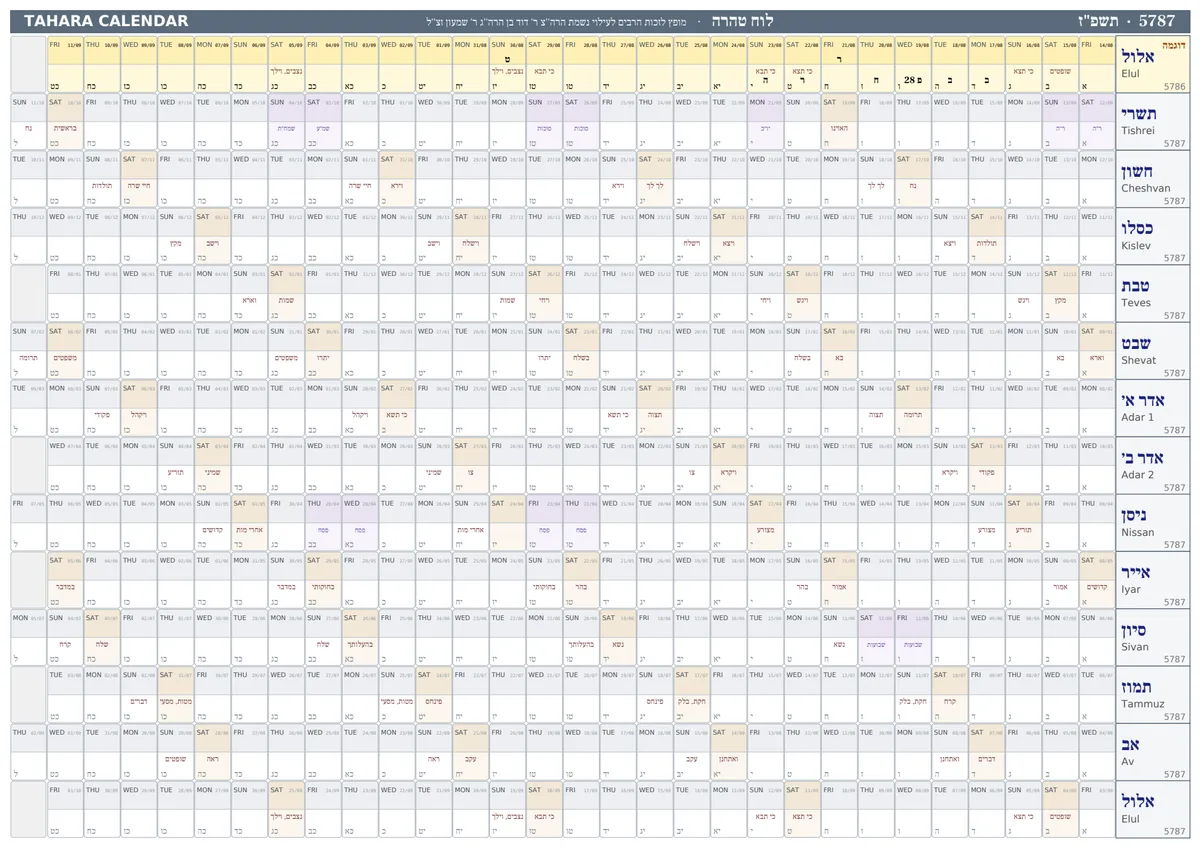
A full year on a single sheet —
and the vesos find themselves.
לוח טהרה — שנה שלמה על גליון אחד
Free — always
No signup
Any year — leap years too

שנת תשפ"ז · 5787
A full year on a single sheet —
and the vesos find themselves.
לוח טהרה — שנה שלמה על גליון אחד
What this is
This is a printable luach tahara — a calendar a woman keeps by hand to record the days of her cycle and to mark the vesos, the days ahead on which she needs to be careful.
It prints on two A4 sheets. The first is the grid she writes on: one row for every Hebrew month of the year, thirty cells across each row, each cell split into a night onah and a day onah. The second explains every marking, in Hebrew and in English side by side.
It is free. There is no signup, no account and nothing collected — it is distributed לזכות הרבים, and anyone may print it, copy it and give it out.
A closer look
Every cell carries the weekday, both dates and the parsha — and still leaves room to write in by hand, in the half of the day it happened in.

The idea
Every row of the luach is one Hebrew month, and every row is aligned by day of month — day 1 at the right-hand end, day 30 at the left.
So the cell directly below a re'iyah — the very same position, one row down — is always the same Hebrew date. That is the veset hachodesh.
And because a Hebrew month is either 29 or 30 days, that same cell is also day 30 of the count in a 29-day month, or day 31 in a 30-day month — and the other of the two sits in the cell beside it. Both are marked.
No counting.
Just look down.
This is the whole reason the luach is laid out the way it is, and why it is never reflowed into weeks: a seven-column calendar would destroy the alignment, and with it the one thing that makes the vesos easy to find.

What you get
Every month of the year stacked one under the other — no flipping, no searching.
Each cell is split in two, because the Hebrew day begins at sunset. Write the mark in the half it happened in.
The cell below a re'iyah is the veset hachodesh — and day 30 or day 31 of the count.
And it is not a wasted row — it is Elul itself, a real month she can track as normal.
Thirteen months when the year needs them, with Adar I and Adar II. Nothing to choose, nothing to check.
The parsha on Sunday and Shabbos, and yom tov in its own colour — so she always knows where she is in the year.
Two pages
The grid she marks by hand, and a page of instructions explaining every symbol — Hebrew in the right column, English in the left.
How it works
A4, landscape, at actual size. Hang it up, or keep it in a siddur.
An R at the time of the re'iyah — in the night half or the day half, whichever it was.
The cell directly below is the veset hachodesh, and day 30 or 31 of the count.
The markings
She writes the Hebrew letter; the English letter beside it is the key to it, and mirrors it — ר→R, ה→H, ט→T, ב→B, ח→C, פ→P.
The count starts from the day of the re'iyah itself, which is day 1. All of this is set out again on page two of the luach.
Scope
The halachic content is deliberately limited to what is safe to put in print. Anything that needs a psak is left to a moreh horaah.
These were left out on purpose. They are not things that should be ruled on in print.
Questions
The current Hebrew year. The luach opens with Elul of the previous year, so you can start using it before Rosh Hashana — and that Elul row doubles as the worked example.
Handled automatically. The generator checks the year and prints thirteen months when it needs to, with Adar I and Adar II. There is nothing to choose and nothing to check.
Yes. Page two has a box to fill in by hand with last year's record — the last re'iyah, the last haflagah, and a kavua veset if there is one — and you carry on from there.
No. Every cell prints both the Hebrew and the civil date, along with the day of the week.
A4, landscape, at actual size — 100%, not "fit to page" — and single-sided. Fit-to-page shrinks the grid and the cells become too small to write in.
The very same luach, enlarged across four A4 sheets which tape together into an A2 wall poster. Each sheet repeats about two centimetres of its neighbour at the seam so you can line them up.
No. It is free, with no signup and no personal details of any kind. It is distributed לזכות הרבים, and you may print, copy and hand it out to anyone.
Haskamos
No haskamos yet — to be added, אי״ה.
Rabbinic approval pending
Download
Free, no signup. Print it, copy it, hand it out.
A4 · 2 pages · PDF
A4 · Landscape · Actual size (100%) — not fit-to-page · single-sided.
For the poster, each sheet repeats about two centimetres of its neighbour at the seam. Overlap them until the duplicated content lines up, then tape.
 Scan for quick access